
Wealth management is no longer defined by a single operating model. In 2026, the industry spans RIAs, multi-family offices, private banks, and hybrid advisory firms; each with distinct client profiles but shared structural challenges.
Complexity is rising across every segment. Portfolios are more diverse; clients expect radical personalization, and regulators demand granular proof of fiduciary care. Advisors now expect technology that does more than just organize data; they expect it to actively assist in the advisory process.
In 2026, winning wealth firms will not be defined by assets under management or product breadth, but by their ability to unify intelligence across the entire wealth ecosystem.
A Converging Wealth Landscape
While RIAs, family offices, and private banks serve different tiers of wealth, their operational realities are converging. All segments face fragmented data across custodians, growing exposure to private markets, and the pressure to scale advice without exponentially increasing headcount.
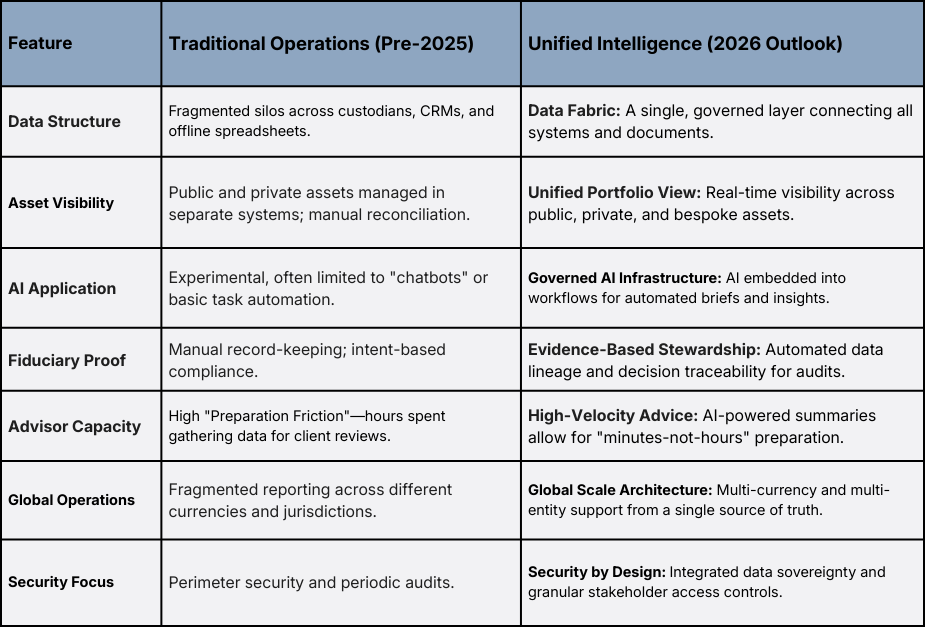
This convergence is forcing a shift toward a unified intelligence layer. By connecting custodians, CRMs, and portfolio systems with proprietary documents, firms can finally move past data silos. The most successful organizations in 2026 are those that have transitioned to a "Data Fabric" approach, governing information in a single layer that supports multiple business models simultaneously.
Private Markets Become the Operating Center
Alternatives, private credit, and bespoke structures are no longer peripheral; they are integral across the wealth spectrum. In 2026, wealth firms must manage public and private assets with equal rigor and visibility.
The industry has moved beyond siloed systems that create blind spots in performance and liquidity. Success now depends on unified multi-asset intelligence that provides consistent analysis and oversight, allowing advisors to view a client’s entire wealth stack, public and private, through a single lens.
AI Shifts from Experimentation to Infrastructure
AI adoption in wealth management has matured significantly. The focus has shifted from experimental chatbots to embedded infrastructure. Firms now require AI that surfaces material changes, prepares advisors for high-stakes meetings, and supports client conversations without compromising accuracy. The new standard is Governed AI Intelligence: an infrastructure that sits directly on top of trusted data and documents, ensuring every insight remains explainable, auditable, and aligned with firm-wide compliance protocols.
Fiduciary Duty Expands to Evidence-Based Stewardship
Regulatory expectations have evolved. In 2026, fiduciary duty is evaluated based on evidence, not just intent. Wealth firms must be able to demonstrate exactly how recommendations were formed and how portfolios were monitored over time.
This requires embedding data lineage and traceability into everyday workflows. When every decision and insight can be reconstructed and defended, advisory and compliance teams can operate with a level of confidence that traditional manual record-keeping could never provide.
Elevating Advisor Capacity
Despite the rise of digital tools, advisor time remains the finite resource that limits scale. Whether serving mass affluent or ultra-high-net-worth clients, the overhead of preparation often stifles growth.
Leading firms have solved this by automating preparation. By utilizing AI to generate household summaries, market briefs, and change-detection reports, advisors are liberated from manual data assembly. In 2026, the hallmark of a leading firm is an advisor who spends 90% of their time advising and 10% preparing, rather than the reverse.
Security and Data Sovereignty
With sensitive data spanning multiple jurisdictions and generations, security is no longer a "feature", it is a prerequisite. Encryption and access controls are now assumed as baselines.
In 2026, the differentiator is Security by Design. The industry’s leading platforms prioritize data sovereignty and granular control, ensuring that sensitive family and firm information remains protected while remaining instantly accessible to the right stakeholders at the right moment.
Resilience Through Unified Intelligence
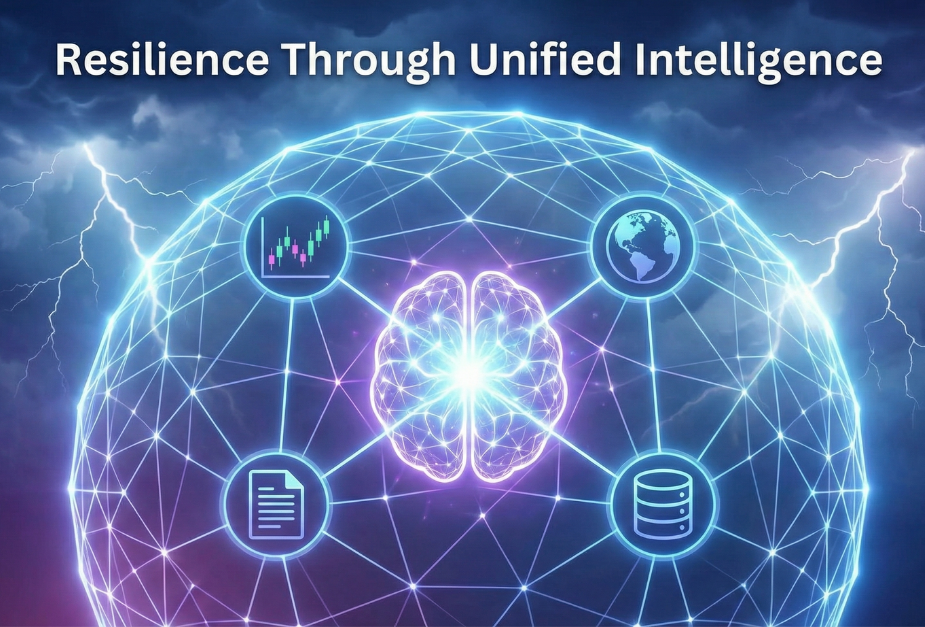
Volatility and regulatory shifts will continue to test the wealth management sector. The most resilient organizations are not those with the most tools, but those with unified intelligence.
Resilience in 2026 is built on a foundation that connects data, documents, and decisions into a coherent whole. By moving away from fragmented reporting and toward a single, explainable intelligence layer, firms gain the clarity needed to navigate global complexity with confidence.
The Evolution of Wealth Management: 2026
The transition from traditional operations to a unified intelligence model marks the difference between firms that are merely managing data and those that are scaling expertise.
Looking Ahead
For modern wealth management firms, 2026 is not about choosing between different software solutions for different segments. It is about establishing a single intelligence foundation that powers the entire ecosystem.
By unifying data, governance, and AI, firms can finally preserve the nuances of their business models while gaining the scale of a tech-forward enterprise. The future of wealth management is no longer about gathering information; it is about unblocking knowledge.
Want to see Clarista on your data?
20-minute working demo: bring your messiest workflow, we'll build a working app on your data while you watch.
Book a demoFrequently asked questions
What is this article about?
RIAs, private banks, and family offices are prioritizing unified intelligence, the ability to see the entire wealth ecosystem through a single lens.
Who is Clarista and why does this matter?
Clarista is the enterprise AI app builder and data fabric that turns trapped enterprise knowledge into decision-ready intelligence, with the security, governance, and audit trail that real businesses need.
How do I get a demo of Clarista?
Visit /book-demo to schedule a 20-minute working session. Bring your messiest workflow and we will show how Clarista works on your data.