AI data governance in financial services is the operational structure of policies, controls, and data lineage that ensures AI systems process accurate, auditable, and compliant information from ingestion to final output. In 2026 it is no longer a forward-looking strategy discussion: regulators are actively penalizing AI-driven failures by applying long-standing rules, FINRA Rule 3110, Reg S-P, and fiduciary duty, to new technology. No new law was needed.
- Enforcement without new laws. FINRA Rule 3110, Reg S-P, and the new 2026 FS AI RMF create a definitive compliance floor using existing fiduciary and supervisory rules.
- The new Treasury standard. The Financial Services AI Risk Management Framework (FS AI RMF), released February 19, 2026, outlines 230 control objectives with a staged maturity model starting at 21 baseline controls.
- The vibe-coding leakage vector. Developer adoption of AI assistants like Claude Code, Cursor, and Copilot has introduced major data exposure risks. Shadow AI usage adds an average of $670,000 to standard data breach costs.
- The visibility deficit. Only 30% of organizations have complete visibility into their AI data pipelines, which keeps the other 70% stuck at proofs of concept.
Why AI Data Governance Is the Defining Compliance Problem of 2026
The operational disconnect across the industry is stark. A 2025 EY survey notes that 72% of organizations have integrated AI into operations and 99% are in the process of doing so. Yet a PwC Responsible AI survey reveals that only 11% of executives have fully implemented core responsible AI capabilities like automated data governance or continuous model testing, and a BCG report finds only 26% of companies possess the data maturity required to move beyond isolated proofs of concept into production value.
The financial penalty for ignoring this gap is evident. SEC-registered investment advisers Two Sigma Investments LP and Two Sigma Advisors LP paid a combined $90 million in civil penalties following compliance failures related to algorithmic investment models. The SEC did not need fresh, AI-specific legislation to level these fines; existing fiduciary duties and supervisory requirements were entirely sufficient.
Firms that previously invested in institutional data governance to satisfy BCBS 239 or SR 11-7 now hold a real competitive advantage: they already possess the lineage infrastructure, metadata management, and quality controls that AI projects demand. Firms that bypassed those fundamentals face the costly task of backfilling their data architecture before AI initiatives can safely scale. That backfill is exactly what a governed data fabric is designed to shortcut: connect to systems without copying them, apply quality, access, and lineage controls once, and serve every AI application from the same trusted layer.
What Does the Regulatory Stack Actually Require Today?
FINRA and the SEC: existing rules apply without exception
While federal AI legislation remains absent, financial regulators have made it clear that AI systems must be governed with the same rigor as legacy software.
FINRA Rule 3110 requires member firms to maintain written supervisory procedures governing technology deployment. FINRA explicitly states that GenAI use impacts recordkeeping, customer data protection, risk management, and Regulation Best Interest obligations. SEC Regulation S-P dictates strict privacy safeguards for consumer PII. AI models cannot circumvent these rules, and processing customer data through unvetted commercial models is a direct compliance violation.
FINRA's 2026 Oversight Report: a prescribed GenAI program structure
The 2026 FINRA Annual Regulatory Oversight Report provides an explicit operational blueprint. FINRA recommends a three-tiered taxonomy for enterprise AI use cases:
| USE CASE TIER | REGULATORY REQUIREMENT |
|---|---|
| Low-risk use cases | Excluded from extensive compliance review; minimal tracking required. |
| Prohibited use cases | Explicitly blocked from entering production environments. |
| Higher-risk use cases | Subject to pre-approval workflows, detailed risk mitigation, and active inventory tracking. |
FINRA's recommended pre-approval workflows mandate a documented business purpose, verified data sources, clear model selection criteria, and specific control validation. Crucially, human-in-the-loop oversight is prescribed for any output that influences client decisions or execution workflows, backed by named supervisory owners.
The EU AI Act: global exposure
The EU AI Act is now fully in force for any US institution handling EU client profiles or managing European data flows. High-risk systems, including credit scoring algorithms and automated fraud detection tools, face strict technical documentation, mandatory logging, and algorithmic transparency mandates.
FINOS AI Governance Framework v2.0
Released in late 2025, this open-source practitioner standard maps 46 distinct financial AI risks to discrete technical controls. It bridges the gap between high-level regulatory text and everyday engineering sprint cycles, giving risk and development teams a shared open framework.
What Is the FS AI RMF and Why Does It Matter for Mid-Market Firms?
The most important framework development this year is the Financial Services AI Risk Management Framework (FS AI RMF), published on February 19, 2026 by the US Department of the Treasury and the Financial Services Sector Coordinating Council. Built in collaboration with 108 financial institutions and the Cyber Risk Institute, it details 230 control objectives across seven structural domains, from governance and data management to third-party risk and incident response.
The staged adoption model
For mid-market registered investment advisers, asset managers, and private equity firms, attempting all 230 controls at once is a recipe for operational paralysis. The framework addresses this with a phased maturity model:
- Initial stage (21 controls). The non-negotiable minimum baseline for every firm using AI: clear governance ownership, a baseline model inventory, and core access management rules.
- Minimal stage (126 controls). Adds systematic model validation, documented risk escalation paths, and structured data lineage practices.
- Evolving stage (193+ controls). Full integration of AI risk into enterprise operational risk frameworks, with continuous automated monitoring and automated third-party oversight.
While technically soft law, the FS AI RMF is already being used by examiners to format audit requests, set supervisory expectations, and review third-party vendor contracts. We break down the exam-request lists themselves in What Examiners Are Actually Asking About AI. Alongside the framework, the Treasury released an official AI Lexicon that standardizes definitions across legal, compliance, and engineering teams, removing the friction created when developers and risk officers define terms like "training data" or "model validation" differently.
How "Vibe Coding" and AI Tooling Create Data Governance Risks
The rise of vibe coding, where developers rapidly generate and deploy application layers using tools like Claude Code, Cursor, Copilot, and ChatGPT, has exposed an unprotected attack surface: the developer's environment. Developer adoption of AI coding assistants is approaching universal enterprise use, but the surrounding governance infrastructure has lagged badly. Repositories interacting with unmanaged AI extensions show a 40% increase in credential exposure. In rapid debugging sessions, engineers paste code blocks containing active API keys, database credentials, and internal configuration secrets directly into external LLM prompts.
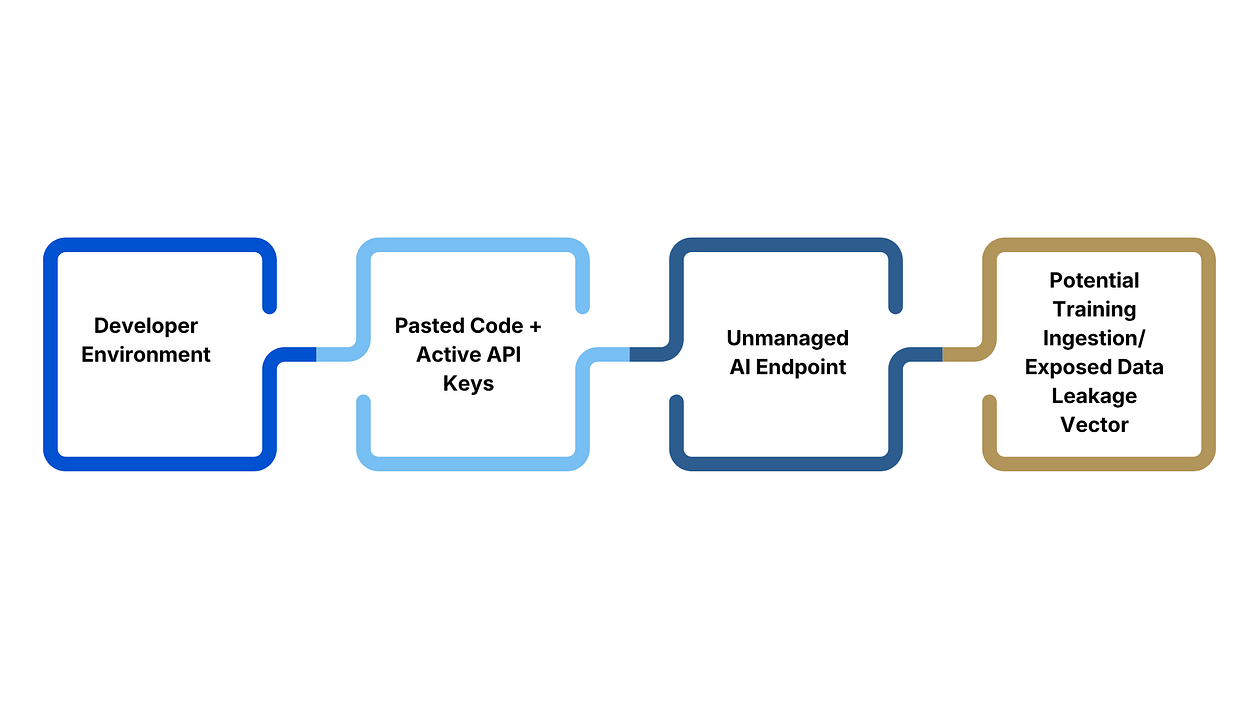
This exposure is systemic. Coding assistants require deep visibility into local codebases to provide relevant context. Without enterprise-managed access controls, intellectual property leakage becomes an inevitable byproduct of daily workflows. We covered the production side of this problem, and how regulated firms get AI-built code through security review, in Enterprise Vibe Coding.
The shadow AI cost, quantified
Data from the 2025 IBM Cost of a Data Breach Report puts explicit numbers on unmanaged AI tools. Shadow AI involvement adds an average of $670,000 to a standard data breach, making it a top-three cost amplifier. 13% of organizations reported direct breaches of their internal AI models or peripheral applications, and 97% of breached firms entirely lacked specialized AI access management or credential tracking controls. Netskope threat research shows 47% of enterprise AI platform users access these tools through personal, unmonitored accounts, and sensitive information disclosure has climbed to number two on the OWASP Top 10 for LLM Applications.
Actionable controls to mitigate developer AI risk
- Mandate enterprise-managed instances. Require tenant-isolated, enterprise-managed instances of all coding assistants with vendor model training on your data explicitly disabled.
- Repository-level DLP. Deploy automated data loss prevention directly in code repositories to block secrets, PII, and sensitive operational code before they reach external LLM endpoints. This is the class of control our code scanning layer enforces on AI-generated code.
- Maintain a tool inventory. Keep an active ledger of all authorized AI platforms. Financial firms overwhelmingly cite tool proliferation as a primary security challenge; blocking unvetted browser extensions is step one.
- Enforce use-case reviews. Mandate pre-approval workflows for any generative AI system that touches production data environments, in line with FINRA recommendations.
The Technical Pillars of a Working AI Data Governance Framework
Data lineage
With only 30% of companies maintaining full visibility into their AI data pipelines, missing lineage remains the primary reason financial firms fail AI compliance reviews. Under Federal Reserve SR 11-7 guidance, validating an AI system for production requires rigorous documentation of data sources, intermediate transformations, and fitness for purpose, a process that typically takes 9 to 12 months of formal approval at major US institutions. To be audit-ready, a lineage system must answer deterministically: where did this training or fine-tuning data originate, what exact filters, joins, or cleaning transformations were applied, what data quality validations ran and what were the scores, and who signed off on this data asset for this specific model.
The compliant model inventory
In line with FINRA's 2026 oversight report and the FS AI RMF Initial stage, firms must maintain a dynamic model inventory. A compliant registry entry contains a clear business purpose and named executive owner, documented data lineage references and training data origins, validation status with performance metrics and last review date, risk tiering mapped to the FS AI RMF or FINOS standards, upstream third-party dependencies (foundation model APIs, hosting providers, vector databases), and defined human-in-the-loop checkpoints for all decision-influencing outputs. The same inventory discipline applies to agentic systems, which we detail in our whitepaper on AI agent governance for financial services.
Third-party and vendor risk management
Modern financial AI systems rarely run entirely on isolated, on-premises infrastructure; they depend on foundation model APIs, cloud-hosted vector environments, and external data suppliers. Under the third-party risk domain of the FS AI RMF, vendor SLAs must be explicitly reviewed for local data residency, strict model versioning controls, independent audit rights, and incident notification windows that align with SEC and Reg S-P compliance timelines.
A Staged 90-Day Implementation Blueprint
For mid-market firms moving from unmanaged AI adoption to a defensible, auditable posture, the 21 baseline controls of the FS AI RMF Initial stage fit a structured 90-day execution window.
Weeks 1 to 4: inventory and classification. Discover all AI systems and developer coding assistants in use via browser, network, and endpoint telemetry to eliminate shadow tools. Classify every tool using the FINRA taxonomy (prohibited, low-risk, higher-risk). Appoint a governance and risk owner for every higher-risk system.
Weeks 5 to 8: data lineage and access controls. Map data ingestion pathways for all production-bound AI infrastructure, documenting every transformation. Migrate technical teams from personal AI accounts to corporate, tenant-isolated enterprise instances. Position automated DLP policies on local code repositories and enterprise LLM proxy endpoints to catch credential leakage.
Weeks 9 to 12: policy formalization and validation. Publish a corporate AI acceptable use policy detailing prohibited workflows and human-review mandates. Embed an explicit SR 11-7 aligned model validation step into the DevOps pipeline for any system moving toward production. Finalize framework documentation with clear ownership across business units, risk teams, and engineering compliance. Wealth and asset management firms that run this sequence enter examination season with evidence instead of intentions.
FAQ
What is data governance?
Data governance is the system of ownership, policies, quality controls, and access rules that makes an organization's data accurate, secure, and usable. AI data governance extends it with model inventories, training data lineage, and controls over what AI systems may read and produce.
What is the difference between data governance and data management?
Data management is the operational work of storing, moving, and processing data. Data governance is the control layer above it: who owns each asset, who may access it, what quality standards apply, and how compliance is evidenced. Management executes; governance decides and proves.
What is AI data governance in financial services?
AI data governance in financial services is the operational system of policies, technical controls, and auditable processes that ensures AI systems run on accurate, compliant, and fully mapped data across their entire lifecycle. It covers data lineage, model registries, access management, vendor risk, and explicit alignment with regulatory expectations like FINRA Rule 3110 and the FS AI RMF.
Is AI data governance legally required by US financial regulators?
There is no single omnibus federal AI statute, but the SEC and FINRA have clarified that existing rules apply directly to AI. Regulations covering supervisory systems (FINRA Rule 3110), consumer data privacy (Reg S-P), and fiduciary duties (Investment Advisers Act) mean firms are already legally accountable for AI-driven data exposures or algorithmic failures.
See governed, explainable AI on your own data. Thirty minutes, your CISO welcome.
Book a demo