By Suvrat Bansal, Founder & CEO
The short version: AI has collapsed the cost of building software to near zero, so the constraint has moved. The question is no longer whether a firm can build the application, but whether its data, security, and compliance posture can survive once the application exists. Data strategy is now the single most important determinant of competitive advantage in the AI era.
For two decades, data strategy in financial services was an infrastructure conversation. Firms ran multi-year programs to consolidate warehouses, treating data as something to be cleaned and stored before it could be useful. That work mattered, but it was paced for a world where applications arrived slowly, built by engineering teams over quarters. That world is gone.
What is the point-to-point integration trap?
When applications were owned by external SaaS players, wiring separate connections to custodian feeds, CRMs, and document stores was an acceptable cost. When applications proliferate rapidly, this pattern becomes an unmanaged risk. Every quick application that spins up its own link to source systems creates a new copy of sensitive client data in an unmonitored location.
Multiply that by dozens of applications, and a firm no longer has a data architecture. It has a sprawl of point-to-point integrations. The work these applications produce vanishes into individual chat windows and cannot be audited. When an examiner asks how a decision was made, a one-off application has nothing to show. Speed without a foundation compounds into exposure.
The purpose of a modern data integration platform is to give every application a single, unified, and governed source to draw from and publish to, so access controls, lineage, and audits are managed once, centrally, rather than reinvented insecurely in every application.
The realities of speed and ownership
Traditional IT data programs were never designed for the velocity that AI-driven applications demand. A firm cannot run a six-quarter data-warehouse migration as the prerequisite to an application built in a week. By the time the program ships, the applications have already been built around it, poorly.
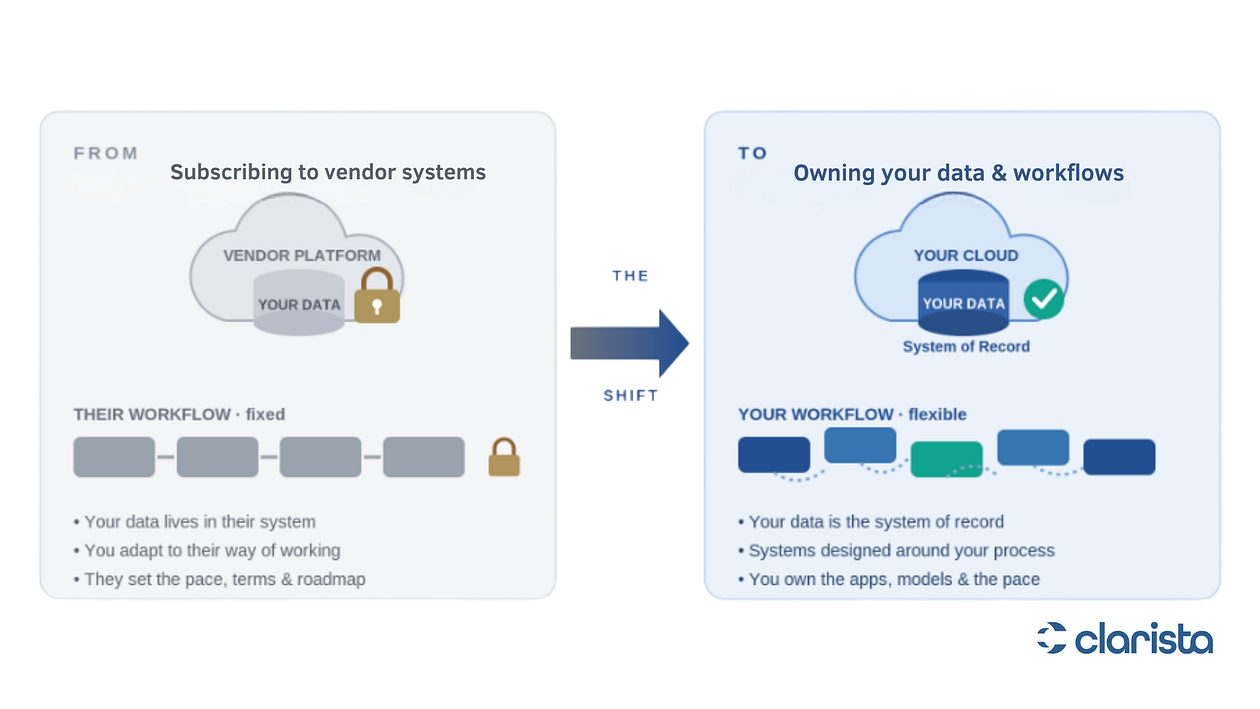
Faced with pressure to move fast, many firms sign up with platform providers who normalize data into proprietary schemas. This brings immediate relief but creates long-term dependency. The model layer of the AI stack is easily swapped; models improve every quarter and are increasingly interchangeable. The data and application layers are not. Whoever controls those controls the firm's advantage.
The Clarista model: turning prototypes into regulated reality
Clarista is built on a different premise: the data, the application, the model APIs, and the governance stay inside the client's secured cloud environment. Ownership stays 100% with the client.
At the center sits the Clarista AI Data Fabric. It connects to systems without copying them, applies quality controls, access controls, and lineage once, and serves a single trusted picture to every application. The data an application creates is published back through the same governed layer, converting outputs into reusable, auditable assets.
- Advisor Brief: an automated briefing agent pairs recent CRM timeline entries with direct portfolio accounting feeds, dropping preparation time for client reviews by 40%.
- Household 360: reconciles fragmented accounting across business entities and multi-generational trusts into a single golden record.
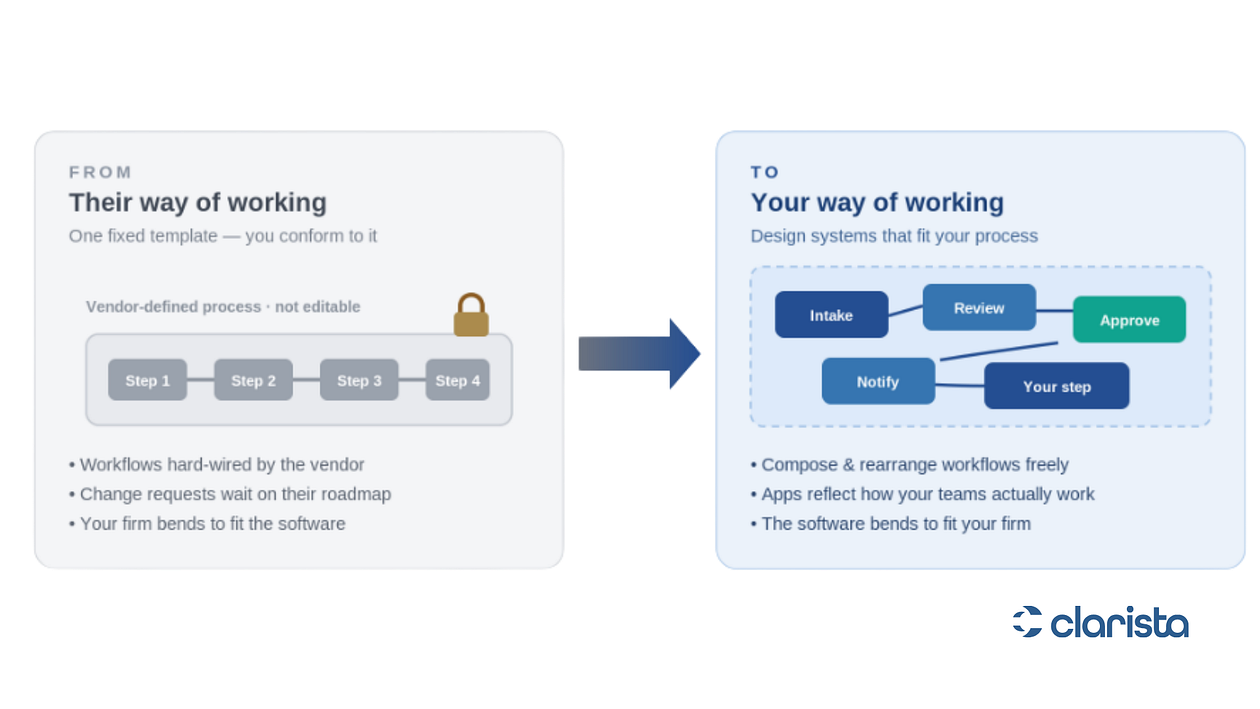
Five operational services run alongside the fabric to make rapidly deployed applications enterprise-ready: Data-Ops (sourcing, governance, lineage), Sec-Ops (identity and entitlements enforced at the point of retrieval), Reg-Ops (compliance and auditability of data, prompts, and outputs), Dev-Ops (managed deployment inside the client's cloud perimeter), and Fin-Ops (cost monitoring across models and infrastructure). Auditability is not an add-on feature; it is an inherent property of the governed layer, the same discipline behind shipping AI-built apps to production.
Beyond wealth management
While wealth management highlights these challenges clearly, the same collision faces private credit, asset management, banking, and insurance. For the advisor-side case, why a sixty-year client promise demands an owned stack, read The Sixty-Year Promise. Firms building AI applications on point-to-point connections inherit identical exposures.
The promise of AI is real, but it will be delivered only by firms whose data strategy allows them to move fast without losing control. Firms choosing ownership and a governed fabric today will own their advantage. Those that outsource their infrastructure will spend the next decade renting it back on someone else's terms. Data strategy is no longer the project you finish before the AI work begins. It is the moat.
FAQ
What is data integration?
Data integration is the practice of combining data from separate systems into a consistent, usable view. In wealth and asset management that means connecting custodians, CRMs, portfolio systems, and document stores so applications and AI work from one trusted picture instead of copies scattered across tools.
What are data integration tools?
They fall into three families: point-to-point connectors and ETL pipelines that copy data between systems, iPaaS platforms that centralize those pipelines, and governed data fabrics that connect to sources in place, applying quality, permissions, and lineage once. The first two move data; a fabric governs access to it, which is what AI workloads and auditors actually require.
What is real-time data integration?
Access to source data at the moment of the query rather than through overnight batch copies. For advisory workflows, it is the difference between answering from yesterday's export and answering from the live book, with the same permissions and audit trail either way.
What are data integration best practices for regulated firms?
Connect without copying where possible, apply access controls and PII masking at the point of retrieval, capture lineage on every query, and publish application outputs back through the same governed layer so they become reusable, auditable assets rather than new silos.
See governed, explainable AI on your own data. Thirty minutes, your CISO welcome.
Book a demo